
Printing Supplies Direct
12 x 18 Frosted Laser Film for Screen Printing Positives
SKU:PSDSFLC12x18
Couldn't load pickup availability
Free Shipping
on ALL cases
Made in
the USA
Performance
Guaranteed
Description
Description
This laser film for screen printing positives turns a compatible laser printer into in-house film output, so you can produce film positives the same day the art comes in. Each 12 x 18 sheet is a frosted 4 mil (100 micron) polyester base, coated on both sides, with a background UV density of 0.07 to 0.08. Fused toner blocks UV light during exposure, while the open areas pass it through to harden the emulsion. You print the art, expose the screen, and start printing, with 100 sheets in the box to keep a busy screen room supplied.
It's built for screen printers who want high quality film positives without sending art out or running a dedicated inkjet setup. The base is in-line stabilized for dimensional and heat stability, so sheets hold their size through the fuser and multi color designs stay in registration from screen to screen.
Features
Features
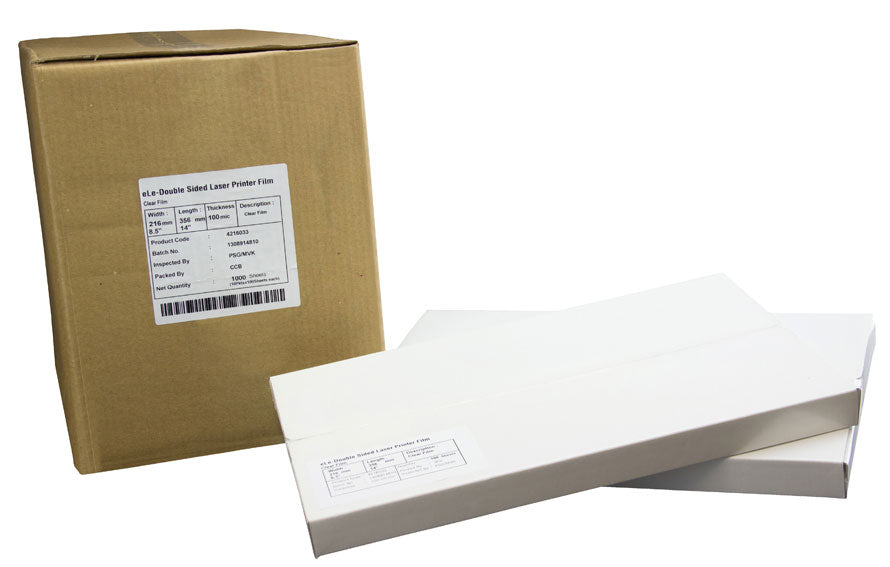
Frosted Matte Finish for Toner Adhesion
The frosted coating gives fused toner a textured surface to grip. On a slick, untreated sheet, toner sits on top and can flake or scratch during handling. On this film, it bonds into the matte finish, so solids stay even and fine detail stays sharp from the printer to the exposure unit. The coating also produces a UV resistant image at lower toner consumption, so you aren't burning through toner cartridges to create a usable black or giving up image quality.
Low Background UV Density
Background density is how much light the film itself stops in the non-image areas. At 0.07 to 0.08, this base passes roughly 85 percent of the light, so exposure times don't stretch to push UV through the sheet. That leaves a wide gap between the open areas and the toner, which gives you room to expose fully without undercutting sharp detail. It's also why this film suits cost effective black film positives: you get a clean stencil without stacking extra toner on every print.
Stability for Multi Color Registration
Film that shrinks or stretches in the fuser won't register. In-line stabilization keeps this polyester base dimensionally stable, so film positives printed one after another line up when you stack them on the light table. On a four-color screen printing job, that's the difference between tight registration and visible gaps or overlaps on the shirt. At 4 mil, the sheet also has enough body to feed and lie flat on the exposure glass, for consistent performance from the first sheet in the box to the last.
Compatible With Most Laser Printers
The film is compatible with most laser printers. For the 12 x 18 size, confirm your printer accepts 12 x 18 sheets through its tray or bypass and offers a transparency or heavy media setting. An anti-static coating cuts down on sheet cling and dust pickup, so each sheet feeds cleanly and the toner image stays smooth.
Product Specifications
- Size: 12 x 18 inches.
- Quantity: 100 sheets per box.
- Base: dimensionally stable frosted polyester film.
- Film base: 100 microns (4 mil).
- Total thickness: 105 microns (4 mil).
- UV coating: double side coated.
- Background UV density: 0.07 to 0.08.
- Anti-static coating.
- In-line stabilized for dimensional and heat stability.
- Compatibility: most laser models.
Need a smaller sheet? The same film comes in an 8.5 x 11 frosted film box and an 8.5 x 14 frosted film box, each with 100 sheets. We also carry a frosted film with a denser 0.50 to 0.60 background, available as 12 x 18 frosted laser film, 11 x 17 frosted laser film, and 8.5 x 14 sheets with the denser base. Browse every size in our frosted laser film collection, or see our clear laser film if your workflow calls for a clear base.

What Laser Film for Screen Printing Positives Is Used For
In screen printing, a film positive is a full-size, opaque black copy of one color in your artwork on transparent film. During exposure it sits between the light source and an emulsion-coated screen. Toner areas block light, so the emulsion underneath stays soft and washes out to open the stencil, while everywhere else it hardens. Each color in a design needs its own film positive and its own screen.
Laser printing film positives is well suited to spot color work: logos, text, and simple color separation jobs for apparel, posters, signage, and flat stock. Toner creates crisp vector edges and solid fills quickly, which makes laser output a practical choice for shops printing film positives every day. Large solids and fine halftones are where it reaches its limits, since laser printing generally produces lower toner density than an inkjet printer set up for film.
The 12 x 18 sheet gives you room for full front and back shirt prints with registration marks outside the image area, where an 11 x 17 sheet can get crowded. You can also gang several left-chest or sleeve film positives on one sheet and trim them apart, which saves film and money on every box. For emulsion, coaters, and the rest of the screen room, see our screen printing materials and supplies.
When to Choose Laser Film
Go with laser when you already own a laser printer, most of your screen printing jobs are spot color and text, and you want film positives that are dry and ready to handle as they leave the tray. There's no ink to smear and no print heads to clog, so you can focus on the print run. It's a common setup for screen printers running mostly spot color.
When to Choose Inkjet Film and a Black Ink System
Choose waterproof inkjet film when you need maximum black density, fine halftones, or simulated process separations. Many screen printers run an Epson SureColor with a black ink system, where every cartridge is filled with black ink, and drive it with RIP software such as FilmMaker to control ink load and halftone dots.
An Epson SureColor set up this way can produce film positives with very dense, opaque blacks, and the RIP software handles halftone screening a standard driver can't. Our 11 x 17 waterproof inkjet film uses a microporous matte coating that dries quickly and resists water, and you'll find the full range in matte waterproof inkjet film and gloss waterproof inkjet film.
Keep each film in the printer it's intended for. Unlike inkjet media, this film has no ink-receptive coating, so ink won't dry or hold on it. Inkjet film's coating isn't made for fuser temperatures, and running it through a fuser can damage both the film and the printer.
Frequently Asked Questions
Is Laser Printing Better Than Inkjet for Film Positives?
It depends on the job. Laser printing is fast, clean, and cost effective for spot color and text, with good edge quality, and the toner image is dry right away. Inkjet printing with a black ink system and RIP software reaches higher black density, which is critical for fine halftones and simulated process work. Many screen printers keep toner-based film for everyday spot color and use screen printing inkjet transparency film for detailed art.
What Is a Film Positive in Screen Printing?
A film positive is an opaque black image of one color in your design, printed on transparent film. It blocks light during exposure, so the emulsion under the image stays soft and washes out to form the stencil. Each color needs its own positive. Laser, inkjet, and imagesetter output can all produce quality film positives on the right film.
Why Choose Frosted Film Over Clear?
The frosted surface gives toner more to grip, which keeps solids dense and edges sharp through handling and exposure. This film's low 0.07 to 0.08 background density keeps the frost from adding much to your exposure time, which is why many shops choose frosted laser film for screen printing. If you prefer a clear base, see our clear laser film options.
Can You Laser Engrave Screen Printing Screens?
Laser engraving is a different process from laser printing. In textile rotary screen production, lasers engrave the stencil directly into a coated screen, and computer-to-screen systems image flat screens without film. Both cost far more than a desktop printer. For most shops, film positives printed on toner-ready film and a standard UV exposure unit remain the practical route to quality screen printing stencils.
What Are the Pros and Cons of DTF Printing?
Direct-to-film (DTF) printing uses an inkjet printer to print a design onto PET transfer film, which is coated with adhesive powder, cured, and heat pressed onto the garment. It needs no screens, no film positives, and no color separation, so you can create full color transfers and short runs quickly. The trade-offs are a higher cost per print on large runs, a transfer layer you can feel on the shirt, and wash durability that depends on the press and powder. For high-volume spot color work, screen printing from film positives is usually the more cost effective method.
Order this 12 x 18 laser film in boxes of 100 sheets, or browse our full range of screen printing supplies. Every order ships with free shipping to the contiguous 48 states. For help choosing film for your printer, call 860-516-6393 or email info@printingsuppliesdirect.com.
By the Printing Supplies Direct Team.