Mitsubishi polyester printing plates are built for shops that live on two-color offset work and carbonless form runs, where stretch resistance keeps registration tight across multi-color passes and repeat jobs. Compatible with an Itek platemaker and an Eskofot platemaker, they drop into workflows forms and short-run shops already run, without the processor stage and chemistry overhead of aluminum. For letterhead, NCR sets, and short-run business printing that reorders on a schedule, that dimensional stability is what keeps proofs short and waste low.
Where Mitsubishi Polyester Plates Perform Best
Two-Color and Carbonless Form Work
These plates are at home on form-heavy schedules. Two-color letterhead, business forms, and carbonless plate printing for NCR sets all benefit from a plate that holds register across the second pass and across repeat runs. Mitsubishi polyester plates keep dot placement stable so the back-printing and color line up where the layout intends, run after run.
For short-run business printing where margins are thin and reprints hurt, that consistency protects both the schedule and the paper. If a job outgrows what polyester handles comfortably, our aluminum offset printing plates cover the higher-volume end of the catalog.
Built Around Itek and Eskofot Platemaking
Plenty of forms and short-run shops still run platemaking equipment that has earned its place on the floor. These plates are compatible with an Itek platemaker and an Eskofot platemaker, so they fit existing workflows without new capital outlay. The stretch-resistant construction is what makes that pairing worthwhile: when plate repeat accuracy drives the job, a plate that resists dimensional drift keeps multi-color and repeat work in register.
If you're also stocking film or other plate formats for those systems, compare options in our offset plates and film collection to keep one supplier behind the platemaking bench.
Polyester or Aluminum: Choosing for Your Press and Run Length
Run Length, Setup, and Cost
The decision tracks run length and budget. Polyester is the efficient pick for short to mid runs: lower cost per plate, faster setup, and no processor stage. A two-color offset plate job that repeats on a schedule is exactly the kind of work polyester was made for. Aluminum becomes the better value as runs get long, because its durability holds quality past the point where polyester wears. If your shop also turns no-chemistry desktop work, our PSD polyester laser plates image straight off a Xante or HP printer, giving you a second polyester option for the lightest jobs.
Pairing Plates With the Right Chemistry
Polyester plates run cleaner when the chemistry around them is matched to the surface. Use a fountain solution formulated for polyester-on-press rather than a standard aluminum mix, and confirm your dampening is set conservatively before bringing it up. Our fountain solutions collection lists compatible options for polyester work.
Platemaking and finishing chemistry matters too. Browse plate developers and finishers for the products that support your platemaking equipment, and keep a compatible wash on hand so cleanup never lifts image where it shouldn't. When you're unsure which combination fits your press, our team can point you to a tested pairing.
What Are Polyester Printing Plates Used For?
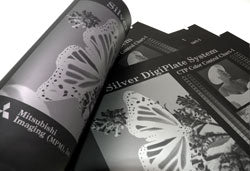
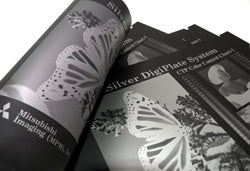
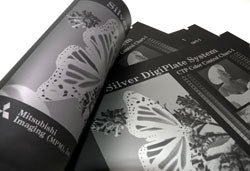
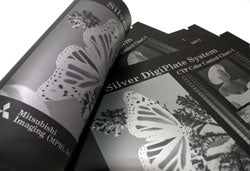
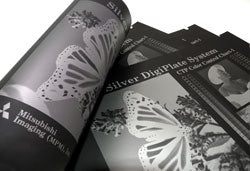
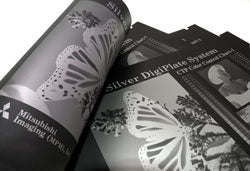
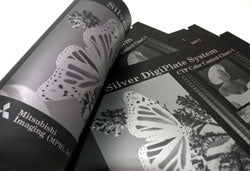
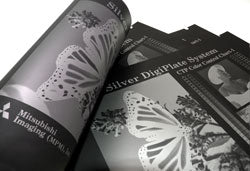
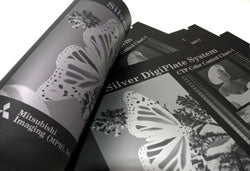
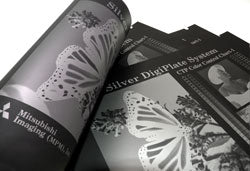
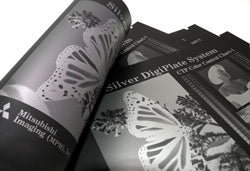
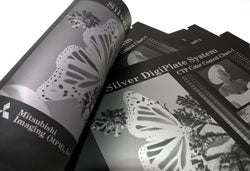
Polyester printing plates are used for short to mid run offset work, and they are especially well suited to two-color business forms, letterhead, and carbonless sets. Mitsubishi's polyester plates are silver plates: they image by the silver diffusion transfer (DTR) process, the same chemistry the Itek and Eskofot platemaking systems were built around, and Mitsubishi rates the polyester base for runs up to 25,000 impressions. The process produces a first-generation plate straight from a platesetter or imagesetter, with no film, stripping, or plate burning. Their stretch-resistant base holds dimensions across multiple passes, which keeps color and back-printing in register on repeat jobs, so shops get consistent forms output without the chemistry and cleanup an aluminum workflow carries.
Mitsubishi Polyester Plate Specifications at a Glance
Registration is where a forms plate earns its keep. A stretch-resistant polyester base resists the dimensional drift that throws a second color out of position, so dot placement stays consistent from the first pass to the second and from one reorder to the next. Because the silver image is laid down as a first-generation plate with no film or stripping stage, fine type, rules, and halftone dots reproduce cleanly enough for one-, two-, and four-color work. That dimensional stability and resolution are what let a shop hold tight registration on two-color and carbonless jobs without the cost and processing of aluminum.
- Material: silver diffusion transfer (DTR) polyester
- Platemakers: Itek and Eskofot
- Best for: two-color forms, letterhead, carbonless (NCR) sets
- Key trait: dimensional stability that holds register across passes and reorders
- Run length: short to mid runs, rated up to 25,000 impressions; high-volume process work suits aluminum
- Workflow: no processor stage or aluminum-plate chemistry overhead
Why Buy Mitsubishi Plates From Printing Supplies Direct
Printing Supplies Direct has stocked pressrooms since 2010, with most orders shipping same or next day and free shipping to the contiguous 48 states. Expedited overnight UPS is available when a form deadline is tight, and every order is backed by our performance guarantee and real technical support from people who run presses. Need a compatible wash to round out the order? See our press washes collection or call 860-516-6393 and we'll help you spec the full setup.
Key Takeaways
- Built for two-color offset and carbonless form work on Itek and Eskofot platemakers.
- Stretch resistance holds registration across passes and repeat runs.
- Lower cost per plate and faster setup than aluminum for short to mid runs.
- High-volume four-color process work is still better suited to aluminum.
Frequently Asked Questions



 Sold out
 Sold out
 Sold out
 Sold out
 Sold out
 Sold out
 Sold out
 Sold out
 Sold out
 Sold out
 Sold out
 Sold out
